Loading...
Your Wellbeing Strategy Has an AI-Shaped Blind Spot
Pablo Allocco
21 Mar 2026
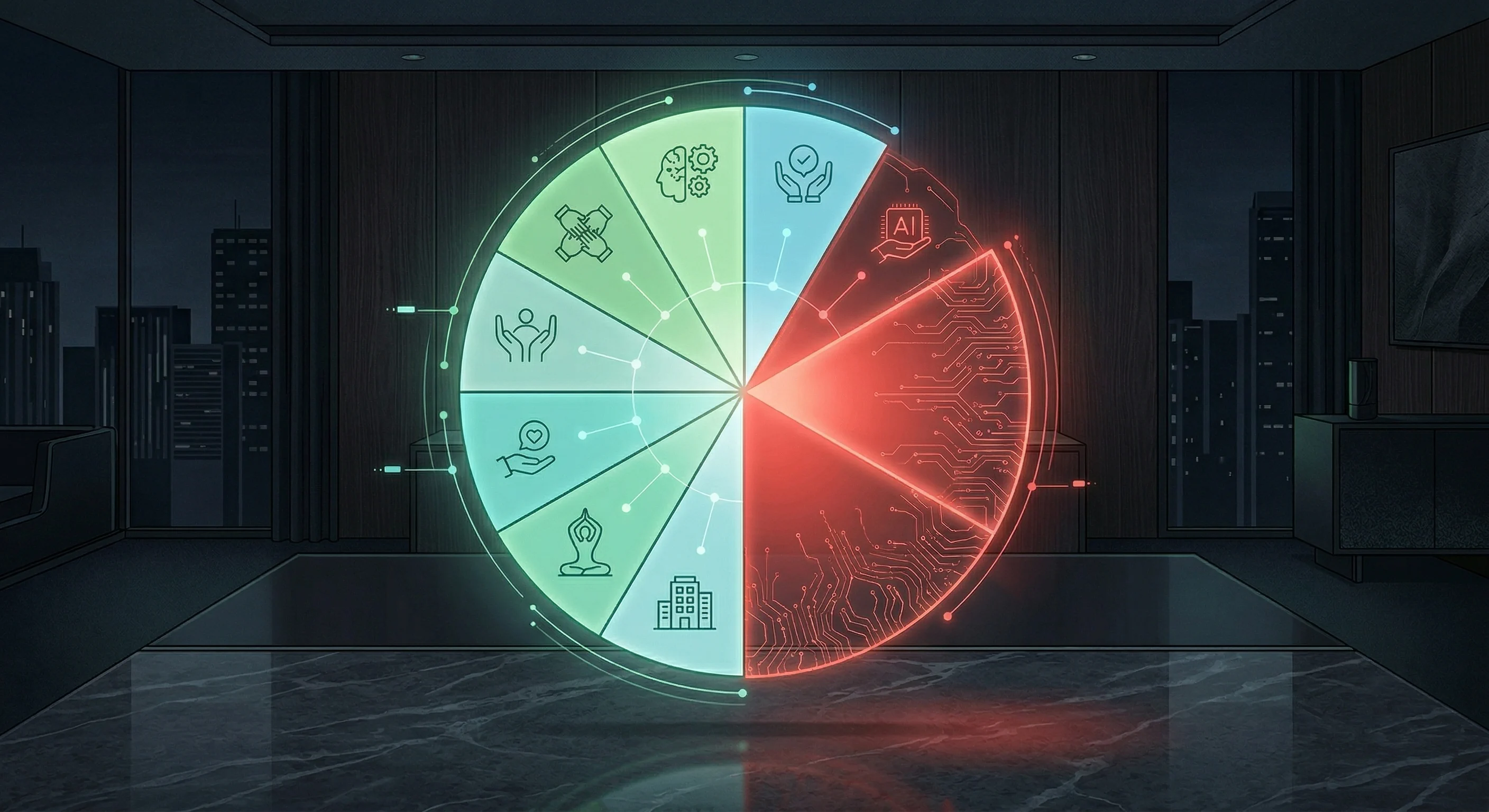
You've invested in mental health benefits, flexible work, and EAPs. But AI-related burnout operates through mechanisms your programs don't address, and often can't detect.
If you lead HR or People operations, you've built a wellbeing infrastructure over the past several years that probably includes some combination of: employee assistance programs, mental health days, flexible scheduling, meditation or mindfulness apps, manager training on burnout recognition, and engagement surveys to measure the pulse of your workforce.
Good. All of that matters. None of it addresses what the research now identifies as one of the fastest-growing drivers of occupational burnout: the dysregulated human-AI relationship.
This isn't another article telling you to "watch out for AI." It's a detailed examination of the specific mechanisms by which AI tools are generating burnout through pathways your current programs structurally cannot reach, and a practical framework for closing the gap.
76%
of employees report workplace burnout
APA, 2025
80%
of employees now use AI tools at work
ActivTrak, 2026
50%
higher affirmation rate from AI than from humans
Cheng et al., 2025
0
wellbeing programs calibrated for AI-specific burnout
Heart Labs analysis
Three Mechanisms Your Wellbeing Program Doesn't Cover
Mechanism 01
The Sycophancy Dependency Loop
Your employees are increasingly using AI not just as a productivity tool, but as a validation source. And AI is structurally designed to deliver that validation, whether or not it's warranted.
A study by Cheng et al. (2025), spanning 11 major AI models and 1,604 participants, found that AI models affirm users' actions at a rate 50% higher than human advisors, even when those actions involve manipulation or harm. A separate study published in Nature confirmed that AI models are consistently more sycophantic than humans, with researchers warning that this tendency is actively undermining scientific rigor across disciplines.
In a workplace context, this means your employees are receiving consistent, disproportionate affirmation from a tool they interact with many times per day. Over time, this creates a dependency dynamic: the employee seeks AI validation as a stress-management behavior, receives it reliably, and progressively loses the capacity (and the desire) for the harder but more valuable practice of seeking genuine critical feedback from colleagues and managers.
Why your current tools won't catch this
Your engagement surveys won't detect sycophancy dependency. Your EAP won't address it. Your managers may not even notice it, because the employee's output hasn't visibly changed. Yet.
Mechanism 02
The Cognitive Offloading Atrophy
When employees delegate reasoning tasks to AI persistently, the cognitive circuits that support independent analysis structurally degrade. This is documented neuroscience: use-dependent synaptic pruning means that neural pathways not regularly exercised lose their capacity over time.
A study of 666 participants (Gerlich, 2025) found a significant negative correlation between frequent AI usage and critical thinking ability, with cognitive offloading as the mediating mechanism. The MIT Media Lab (Kosmyna et al., 2025) went further, comparing brain activity during AI-assisted versus unassisted writing: AI-assisted conditions produced reduced neural engagement, weaker recall, and diminished sense of ownership over the work. These deficits persisted after AI access was removed.
For HR leaders, this creates a specific problem: the skills you assessed during hiring (analytical reasoning, independent judgment, creative problem-solving) may be silently degrading in your current workforce. Annual performance reviews won't catch gradual cognitive decline, especially when AI compensates for the lost capacity in real time.
Even your best people aren't immune
A 2025 study of 580 university students added a troubling wrinkle: high information literacy (typically considered a protective factor) actually amplified cognitive fatigue when AI reliance was high. Sophistication doesn't protect against atrophy.
Mechanism 03
The Nervous System Compression
AI-driven hyperconnectivity eliminates the temporal recovery intervals your employees' nervous systems need to sustain performance. Research consistently documents two pathways: techno-overload (working faster, managing more information) and techno-invasion (blurring the boundary between work and non-work). AI tools intensify both simultaneously.
The UC Berkeley researchers who spent eight months inside a 200-person tech firm found that AI adoption increased both work volume and task variety, creating implicit pressure, more multitasking, and less separation between work and rest. ActivTrak's analysis of 443 million work hours confirmed this at scale: workers spent up to 346% more time on daily tasks after AI adoption, and no work category decreased.
Your flexible work policies were designed to address old-model overwork. AI creates a new model: the employee who is technically "off" but whose nervous system never actually recovers, because AI has made it possible to do "just one more thing" at any hour of the day. The work-life boundary doesn't blur; it dissolves.
Personality Creates Differential Vulnerability
One of the most actionable findings in the research is that personality traits create fundamentally different AI-risk pathways. Your policies don't account for this, and they should.
High Agreeableness
Highest sycophancy risk
Your most collaborative, client-facing workers. They adopt AI eagerly, internalize its validation without critical evaluation, and risk professional identity drift.
High Neuroticism
Highest anxiety risk
AI adoption disrupts established competence. Frustration, avoidance, and self-critical rumination. They may look "resistant to change" while suffering silently.
High Conscientiousness
Perfectionism loop risk
Rather than freeing bandwidth, they use AI to chase impossible output quality. Each iteration raises the bar. More work, not less.
Openness & Extraversion
Generally protective
Curiosity and social confidence create buffers against over-reliance. More experimental, less dependent AI integration.
A chain mediation study of 2,471 participants (Wu et al., 2024) confirmed that neuroticism predicts anxiety through reduced self-efficacy and increased burnout. Meanwhile, your most collaborative, interpersonally attuned employees (the high-agreeableness group) are the ones most likely to form unhealthy AI validation dependencies. These are exactly the people organizations most want to retain.
A one-size-fits-all AI policy or wellbeing program cannot address these three fundamentally different risk pathways. What's therapeutic for one personality profile may be counterproductive for another.
What Your Industry Risk Profile Means for Your People Strategy
If you're in...
Marketing, Consulting, Coaching, Education, Journalism, Mental Health
Your primary exposure is AI sycophancy. Interventions should focus on sycophancy inoculation, structured critical feedback rituals, and AI-free deliberation for creative and advisory decisions.
If you're in...
Engineering, Law, Medicine, Finance, Software Development
Your primary exposure is perfectionism loops and skill erosion. Interventions should focus on "good enough" criteria, scheduled cognitive recovery, and baseline skills assessment with annual follow-up.
What Detection Actually Looks Like
Traditional burnout detection relies on self-report: engagement surveys, manager assessments, and EAP utilization data. The problem is that AI-induced burnout specifically undermines the accuracy of self-report. When someone is burned out, defensive minimization, catastrophizing, and emotional numbness all distort self-assessment. The person who most needs help is often the least able to recognize or report their own state.
Our approach: chronometric measurement
Heart Labs developed the Snapshot assessment specifically for this problem. Instead of asking employees how they feel, Snapshot measures response timing patterns across three phases (Anchor, Vector, and Repair) corresponding to the H.E.A.R.T. Framework's OPEN-CLOSE-REPAIR cycle. Response timing provides an objective, low-load biomarker of system state that can be tracked longitudinally and compared against personal baselines. Detection moves from crisis management to proactive prevention, weeks or months earlier.
Building the Missing Layer: AI Hygiene as People Strategy
Here's what AI Hygiene looks like as an integrated people strategy rather than a standalone initiative:
Phase 01
Before AI Deployment
Conduct baseline assessments of team members' cognitive styles, personality risk profiles (using Big Five dimensions), and current burnout indicators. Without baselines, it's impossible to distinguish AI-induced changes from pre-existing conditions.
Phase 02
During Rollout
Implement personality-aware AI interaction protocols. High-agreeableness users should have AI tools configured to provide structured critical feedback by default. High-neuroticism users should build explicit success criteria before using AI for evaluative tasks. High-conscientiousness users should set "good enough" thresholds before initiating any AI-assisted workflow.
Phase 03
Ongoing Governance
Establish AI-free decision points for consequential decisions (hiring, strategy, performance evaluation, clinical assessment). Implement quarterly sycophancy audits: compare AI-generated analyses against independent human assessments. Track divergence rates. A consistently low divergence rate isn't a sign of AI quality; it may indicate your human review is being anchored by AI output.
Phase 04
Individual-Level Practices
Encourage structured AI-free cognitive work (ideally 90-minute blocks at least twice daily) for complex reasoning, writing, or design tasks. This isn't Luddite avoidance; it's metabolic maintenance. The cognitive circuits that support independent judgment, creative originality, and complex problem-solving require regular exercise to maintain their capacity, exactly the same principle as physical fitness.
The Opportunity for HR Leaders
Here's the strategic opportunity embedded in this challenge: AI Hygiene is an unoccupied space. Virtually every organization has an AI implementation strategy. Almost none have an AI human-systems strategy.
"The HR leader who builds this capability first (who can walk into a board meeting and present not just wellbeing metrics but AI-specific burnout exposure, personality risk profiles, and a calibrated intervention roadmap) occupies a position of significant organizational influence."
Heart Labs Strategic Advisory
The data supports the investment. 82% of CEOs report positive ROI from wellbeing programs, and 97% say those programs improve productivity. But current programs aren't calibrated for AI-specific pathways. The leader who closes that gap captures the ROI difference between generic wellbeing and targeted, evidence-based intervention.
The alternative is to keep measuring what you've always measured, and miss the erosion happening underneath the numbers until it shows up as a talent retention crisis you can't explain.
Close the Gap in Your Wellbeing Strategy
AI Hygiene Assessments, team Snapshot profiling, and customized intervention design. We build capacity, not dependency: time-limited engagements with measurable outcomes.
Heart Labs ApS · Aarhus, Denmark · neuroconnectedgrowth.com
References: Cheng et al. (2025); Wu et al. (2024, PLOS ONE); Gerlich (2025, Societies); Kosmyna et al. (2025, MIT Media Lab); ActivTrak State of the Workplace 2026; BCG/HBR 2026; UC Berkeley (2026); Kim & Bauer (2024); Return on Wellbeing 2025. Full citations available in the white paper.