Loading...
What If a Luxury Purchase Felt Like a Pause? Retail as Repair
Tamara Logica
06 Oct 2026
What if the most valuable thing a brand could offer is not the object, but the pause it creates?
Sales and marketing have spent a century perfecting the push: more urgency, more stimulation, more reasons to buy now. We at HeartLabs keep returning to a different question, one that comes from psychotherapy and sensory integration rather than from the marketing playbook.
What if, instead of pushing customers toward what we want them to buy, we put our resources into creating repairing and learning experiences for them? As a side effect, would conversion go up, down, or stay the same? And what would happen to loyalty, fidelity and trust? We don't know yet. This article separates what research already supports from what we are daring to hypothesize.
The push loop
Stimulate, create urgency, close the sale, repeat. The customer leaves with an object and, often, a little more sensory and cognitive load than they arrived with.
The repair loop (our hypothesis)
Calm the senses, teach something meaningful, show the effect on the body, and let the product earn its value. The customer leaves regulated, informed and connected to the brand.
The experiment: Best of Denmark
We are working with Best of Denmark to design in-store experiences where a customer doesn't just purchase a luxury design item. They learn about Danish heritage and culture, and how it could complement their own culture and roots. The space itself becomes the lesson, built on four ideas.
1. Heritage as a living lesson
Customers explore how Danish design traditions can speak to their own heritage, so a product becomes a cultural bridge rather than just an object.
2. Structured chaos
Textures, materials, colors, geometry and lines are combined so that sensory noise becomes organized, and taste and quality scale in a minimalist, simple way.
3. Real-time biodata
Biological, psychological and neurological signals are shown live, so customers can see how their surroundings and the products in them affect how they feel.
4. The pause bubble
Each item is framed as a PAUSE: a small insulating space where time stops, we reset and repair, and every material speaks to basic needs in a modern life.
What the science already tells us
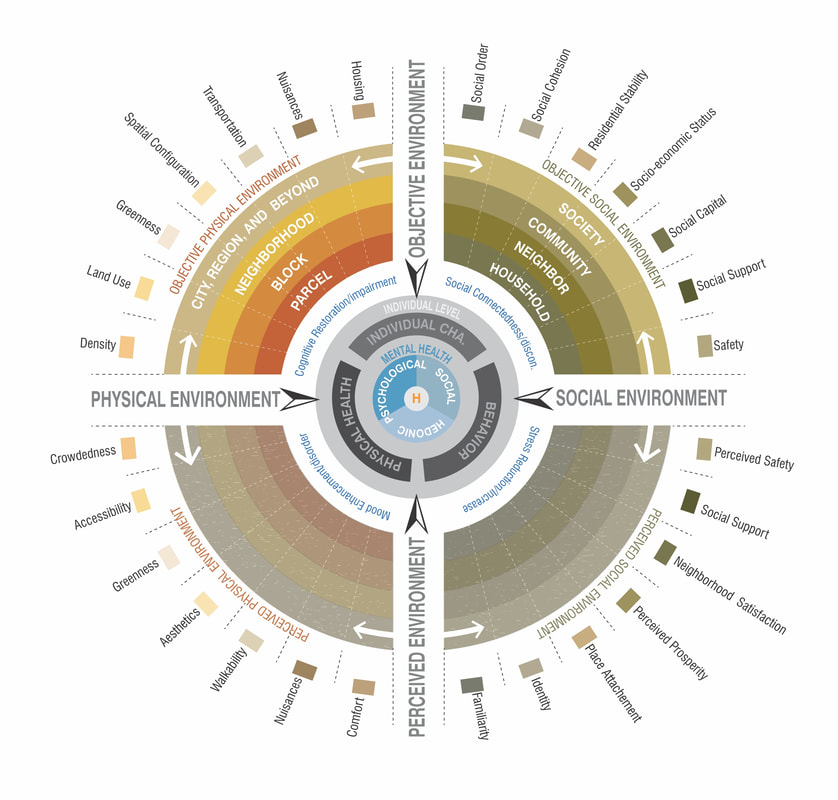
This idea doesn't come out of nowhere. Several well-replicated lines of research suggest that our surroundings are not neutral backdrops. They act on the body and mind all the time.
Your surroundings can change your recovery
In a classic natural experiment, Ulrich (1984) compared surgical patients whose window faced trees with matched patients whose window faced a brick wall. The tree-view group left hospital sooner, received fewer negative nurse notes and needed fewer strong painkillers. Nothing about the surgery differed. The view did.
Data from Ulrich (1984): 23 matched patient pairs. Roughly three quarters of a day shorter, from a window alone.
Nature restores attention and quiets rumination
Kaplan (1995) proposed that natural settings let our directed attention rest and replenish. Supporting this, Berman et al. (2008) found that a walk in nature improved performance on an attention-demanding memory task more than a walk in a busy urban setting. Bratman et al. (2015) went further: a 90-minute nature walk reduced self-reported rumination and activity in a brain region linked to it, while the urban walk did not.
Visual order is easier on the brain, and the brain rewards it
Reber et al. (2004) showed that the easier something is to process, the more pleasing we tend to find it. This is the processing fluency account of beauty, and it offers a plausible mechanism for why simple, well-organized spaces feel calmer. Evans (2003) reviewed evidence linking features of the built environment, including noise and housing quality, to mental health. Even color is not neutral: Mehta and Zhu (2009) found that red boosted detail-oriented performance while blue boosted creative performance.
Retail environments already shape behavior
Bitner (1992) showed that physical surroundings influence both customers and employees, and Krishna (2012) reviewed how the senses shape perception, judgment and behavior in consumer settings. Pine and Gilmore (1998) argued that experiences are a distinct economic offering beyond goods and services. Morgan and Hunt (1994) placed trust and commitment at the center of lasting customer relationships. Our proposal sits at the intersection of these ideas.
Validated, or still a bold question?
We want to be honest about the line between evidence and imagination.
| Statement | Status | Key source |
|---|---|---|
| Surroundings can affect physical recovery | Supported | Ulrich (1984) |
| Nature exposure restores attention and reduces rumination | Supported | Berman et al. (2008); Bratman et al. (2015) |
| Easy-to-process, ordered visuals feel more pleasing | Supported | Reber et al. (2004) |
| Physical environments influence customer behavior | Supported | Bitner (1992); Krishna (2012) |
| A restorative retail space increases conversion | Hypothesis | To be tested |
| Seeing your own biodata makes a product's value tangible | Hypothesis | To be tested |
| Repair-focused brands earn deeper loyalty and trust | Hypothesis | Plausible via Morgan and Hunt (1994); not yet tested here |
What if...
Here is where we get provocative. These are not findings. They are the questions the Best of Denmark experience is designed to explore.
- What if a calm, organized sensory environment lowers the noise enough for customers to decide with clarity instead of impulse, and conversion holds or rises as a side effect?
- What if seeing live physiological signals next to a material, a color or a form lets people feel the value of a product rather than take our word for it? Craig (2002) describes interoception as the sense of the body's internal condition, so showing it could be a way of making that sense visible.
- What if customers who learn to build small bubbles of calm at home keep the brand attached to that feeling, and loyalty and trust grow because the brand gave something back?
- What if a team that works every day on a purpose of repair and learning, rather than pressure, feels differently about its work?
One ethical note: biological and neurological data are deeply personal. Any experience like this needs explicit consent, transparent use and strict privacy protection, in line with European data protection rules.
The journey we are designing
Arrive
sensory reset
→sensory reset
Learn
heritage and craft
→heritage and craft
Experience
structured chaos
→structured chaos
See
live biodata
→live biodata
Pause
take it home
take it home
Your turn: we want your opinion
Do you think this could work in the real market? Have you tried something like it, and failed or succeeded? Would you feel differently working for a brand built on repair instead of pressure? Tell us what you think, because the best versions of an idea like this are built together.
A home, a shop or a product that treats existing in it as already doing something healthy for yourself: that is the pause we want to share with the world.
References
Berman, M. G., Jonides, J., & Kaplan, S. (2008). The cognitive benefits of interacting with nature. Psychological Science, 19(12), 1207–1212.
Bitner, M. J. (1992). Servicescapes: The impact of physical surroundings on customers and employees. Journal of Marketing, 56(2), 57–71.
Bratman, G. N., Hamilton, J. P., Hahn, K. S., Daily, G. C., & Gross, J. J. (2015). Nature experience reduces rumination and subgenual prefrontal cortex activation. Proceedings of the National Academy of Sciences, 112(28), 8567–8572.
Craig, A. D. (2002). How do you feel? Interoception: The sense of the physiological condition of the body. Nature Reviews Neuroscience, 3(8), 655–666.
Evans, G. W. (2003). The built environment and mental health. Journal of Urban Health, 80(4), 536–555.
Kaplan, S. (1995). The restorative benefits of nature: Toward an integrative framework. Journal of Environmental Psychology, 15(3), 169–182.
Krishna, A. (2012). An integrative review of sensory marketing: Engaging the senses to affect perception, judgment and behavior. Journal of Consumer Psychology, 22(3), 332–351.
Mehta, R., & Zhu, R. (2009). Blue or red? Exploring the effect of color on cognitive task performances. Science, 323(5918), 1226–1229.
Morgan, R. M., & Hunt, S. D. (1994). The commitment-trust theory of relationship marketing. Journal of Marketing, 58(3), 20–38.
Pine, B. J., II, & Gilmore, J. H. (1998). Welcome to the experience economy. Harvard Business Review, 76(4), 97–105.
Reber, R., Schwarz, N., & Winkielman, P. (2004). Processing fluency and aesthetic pleasure: Is beauty in the perceiver's processing experience? Personality and Social Psychology Review, 8(4), 364–382.
Ulrich, R. S. (1984). View through a window may influence recovery from surgery. Science, 224(4647), 420–421.
— HeartLabs Team